

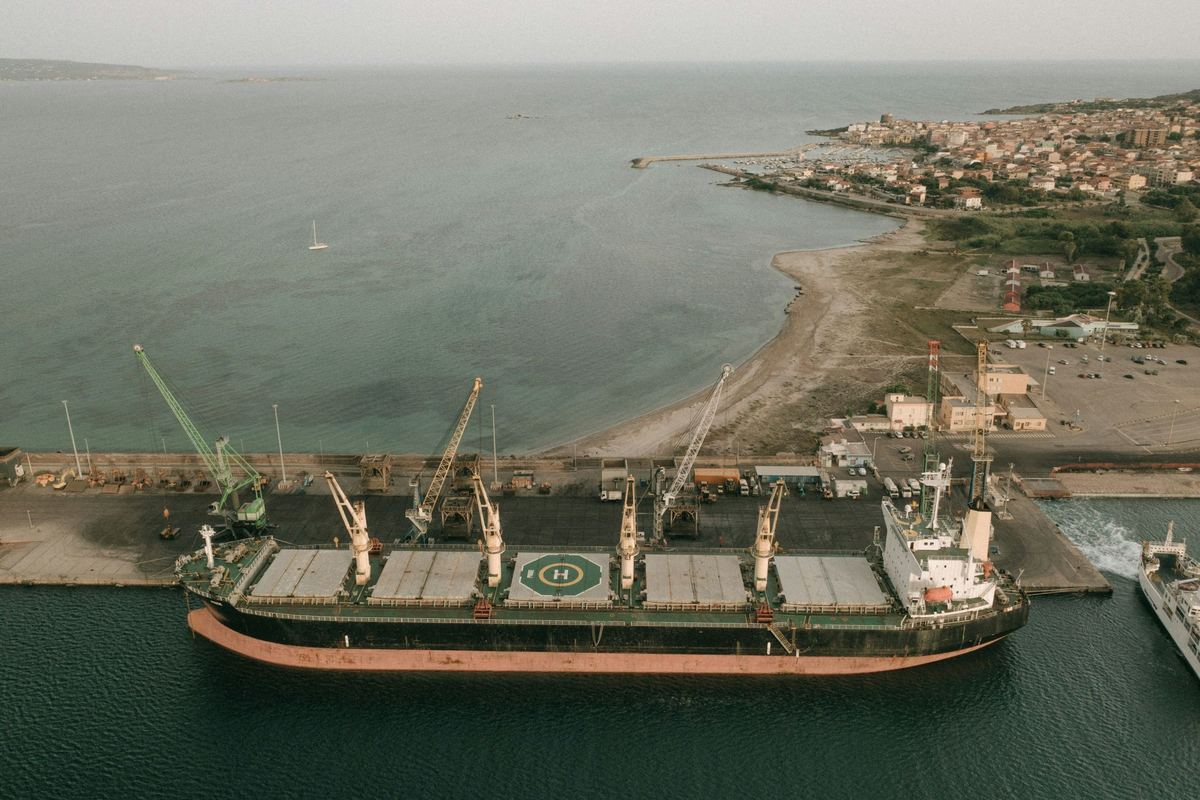
NarinPort coordinates port-to-warehouse haulage on the Gulf of İskenderun through its independent off-dock facility. After stevedoring, cargo is collected from the quay, moved to our facility in a synchronised flow and directed into storage or direct delivery. This critical link needs the right timing and equipment to prevent port storage, demurrage, detention and site waiting costs from growing.
Summary
NarinPort is a port services operator coordinating port-to-warehouse haulage on behalf of cargo owners through an independent off-dock structure. It manages every link through one contact, from post-discharge quay removal and gate exit to weighing, non-bonded warehouse placement and empty return. Independent of a particular pier, it reduces port storage, demurrage and detention pressure through synchronised transfer speed.
Port-to-warehouse haulage is also called quay-to-warehouse haulage in industry practice. After cargo is discharged from vessel to quay, it covers transport to our non-bonded warehouse outside the port yard or the delivery address. It is the bridge between stevedoring and hinterland distribution. On the Gulf of İskenderun, NarinPort performs this link through synchronised removal to its off-dock facility and the discipline of single-contact coordination. Regardless of the discharge berth, because we are not the user of a particular pier, collection from the relevant terminal and removal from the site follow the same standard operational flow.
The terminology for this operation is often confused. First, internal port transport is a short shuttle between the quay and terminal yard or stacking areas; it is not the operation described here. Quay-to-warehouse transport describes a narrower, specific movement. Supalan, meanwhile, is a customs procedure defined under the Customs Regulation, rather than a type of transport.
It is therefore important to position port-to-warehouse haulage correctly within the chain. It comes immediately after tally and before weighing, storage or direct delivery. Its commercial importance follows from this position. If removal cannot match crane discharge speed, cranes start waiting. When cranes wait, the vessel remains longer at berth; port storage accumulates while the container waits in the yard; demurrage risk arises when free time expires; and detention risk arises if the container leaves the port but is not returned on time. Different costs can therefore grow simultaneously.
Haulage exists to break this chain of cost escalation in the short but critical leg between quay and warehouse.
How Does Port-to-Warehouse Haulage Work in İskenderun?
The operation starts at the planning desk before the vessel's ETA notification. When cargo information reaches us, vehicle and trailer selection, truck sequencing and facility arrival plans are calculated according to quay discharge speed. Once discharge begins, the tally clerk records item count, weight and any physical damage marks individually. This record creates the first link in the evidence chain in dealings with the port operator, buyer and potential insurance recourse.
Two flows operate on the quay:
- Discharged cargo is placed in a short-term open-yard point and then transferred to trucks.
- When supalan eligibility is approved, cargo is transferred directly to a waiting truck.
The second flow removes double handling and lowers handling cost, but supalan is not suitable for every cargo.
Gate-out is one of the points most prone to bottlenecks. Plate registration, ISPS port-entry-card checks, document verification including bill of lading copy, delivery order, EIR and electronic dispatch note, K1 authorisation and the driver's valid SRC certificate are checked in sequence. A single missing document or inconsistent record can stop a vehicle and expand the queue behind it. This is a frequent constraint for hinterland manufacturers: their own K2-authorised fleets may not be considered sufficient in every commercial transport and port-gate scenario.
The road segment is often short in İskenderun. Time between quay and off-dock facility is generally measured in minutes. Following facility gate-in, gross weight is verified at the weighbridge for commercial weighing, customs declaration and delivery evidence; unloading, warehouse location assignment or direct delivery then follows. The cargo delivery record is signed, EIR is updated with container condition and empty equipment is returned to the line operator's depot. Empty-container return is the final link; delay at this stage starts detention risk.
Selecting Vehicles, Trailers and Equipment by Cargo Type
The factor determining haulage cost and damage risk is the match between trailer and cargo, rather than the tractor alone. Standard 20-foot and 40-foot chassis often suffice for ordinary containers; HC, open-top, flat-rack and reefer scenarios require more careful planning for chassis, connections and driver. Dangerous goods (IMO/ADR) are not transported.
Iron and steel products require a different operational arrangement. Rolled sheet and steel coils are secured on open trailers using cradle dunnage and appropriate lashing equipment; incorrect securing means coils can slide or overturn on the road and threaten cargo safety. Bars and billets need a different lashing protocol. Slabs, marble blocks and oversized pieces require multi-axle trucks or lowbed trailers.
Tippers are preferred for bulk scrap, alumina and similar cargo; attempting to use ordinary open trailers extends unloading time and increases damage and occupational-safety risks. Project cargo and special equipment may require solutions such as sidelifters or telescopic semi-trailers. We deploy these combinations in the İskenderun hinterland through our contracted carrier pool according to the cargo profile.
We plan the correct equipment combination, rather than leaving a complex technical decision to the cargo owner.
Port Storage, Demurrage and Detention
These terms describe costs paid to different parties, starting at different stages and calculated differently.
- Port storage is paid to the port operator according to the time cargo remains in its yard, often with progressively increasing tariffs.
- Demurrage is paid to the container line when the container remains in the terminal beyond free time.
- Detention is paid to the line when the container is not returned to its depot or designated point on time after leaving the port.
A single shipment can incur demurrage followed by detention.
Quay-to-warehouse speed directly affects all three items. Quick removal limits storage accumulation. The same speed helps cranes run without interruption, reducing vessel berth time, yard congestion and additional operational costs. When gate-in, weighing and delivery proceed with discipline, empty return accelerates and the chain may close before detention starts. The off-dock structure drives this equation: while port storage tariffs rise with time, off-dock non-bonded storage often provides a more economical setting.
Clarity at quotation stage is also part of this equation. Alongside transport, potential items at every step are entered in the quotation in advance. Quay tally, delivery orders in shipment documentation, weighing at gate-in, gate queues and night or holiday overtime are made visible individually. At completion, you do not encounter unfamiliar invoice lines. Leaving no unexplained item between quotation and invoice is the minimum condition for a long-term working relationship at NarinPort.
Supalan, Bonded Warehousing and Direct Delivery: Which Route?
Three main routes are evaluated in haulage. Selection depends on cargo profile, customs procedure, document readiness, number of consignees and site conditions at the delivery point.
Supalan allows goods to be delivered directly to the importer without entering a bonded warehouse under the Customs Regulation. It does not apply to every cargo. Certain product groups, authorised-status companies, high-tonnage bulk shipments, oversized project cargo and some sensitive operations may qualify. It can remove double handling, but requires the declaration, vehicle, driver, site and consignee to be ready in the same narrow time window. A deviation can return the cargo to standard warehousing procedures.
In general industry practice, the bonded-warehouse route moves cargo collected at the quay to a bonded warehouse or temporary storage location. Following declaration registration, tax payment, inspection and delivery arrangements are managed from this area. Cash-flow flexibility is one of its notable advantages. For part-load consignments divided between several buyers on the same vessel, bonded warehousing is often the most suitable solution because it permits sorting by buyer, batch, document or delivery priority.
Direct delivery is the third option. Goods in free circulation or approved for supalan may move in one vehicle from quay to the buyer's factory or warehouse. Cargo characteristics, document readiness, unloading facilities and receiving-team availability determine feasibility.
NarinPort operates exclusively as a non-bonded warehouse and does not offer bonded warehousing; for goods under customs control, the process is coordinated with our contracted customs broker.
The boundaries of each role must be drawn correctly. NarinPort undertakes haulage execution and operational coordination, managing the tractor, trailer, driver, gates, facility entry and delivery flow. Declaration registration, supalan applications and customs-inspection coordination fall within the customs broker's authority. We bring these two roles together at one operations desk without taking on the brokerage role ourselves.
What Does NarinPort Do in Port-to-Warehouse Haulage?
Our off-dock structure directly fits the gulf's multiple-terminal operational environment. Because we are not the contracted user of a particular pier, gate access, document preparation and vehicle planning follow the same standard flow regardless of the discharge quay. We reorganise alternative routes and timing within the operation when sudden bottlenecks arise, such as vessel bunching, gate queues or yard congestion.
Under severe local weather such as Yarıkkaya winds, cranes may reach safety limits and the port authority may suspend discharge temporarily. In such cases, we rebuild dispatch planning as soon as conditions become clear. Because potential overtime, waiting and recall items have already been addressed in our transparent quotation structure, we avoid unexpected costs.
On the equipment side, our contracted carrier pool, working with K1-authorised tractors and certified drivers, joins the operation under the same coordination discipline. Depending on cargo profile, we organise standard container chassis, open and cradle-supported transport, multi-axle trucks, lowbeds, tippers and sidelifters. Through our legally authorised carrier pool, we resolve authorisation, commercial-transport and port-gate restrictions that hinterland manufacturers may encounter with their own K2 fleets, within a single-contact operational flow.
At the facility, our off-dock infrastructure reduces slowdown points. Within a ten-decare site there is 7,000+ m² of covered storage, and the facility operates as a non-bonded warehouse. Appropriate storage is planned according to the goods' customs status. Weighing coordination creates commercial weight records, weight checks for customs declarations and evidence for potential commercial disputes within the same chain.
The principle of one point of contact throughout the chain solves a problem customers frequently experience.
The scenario in which three separate companies pass responsibility between themselves after damage typically arises when stevedoring, haulage, weighing and storage are distributed among different firms. Document and responsibility gaps accumulate at handovers. In our structure, critical records from tally to weigh tickets and EIR to delivery signatures are registered by the same coordination team. If the process stops anywhere, there is one number to call and NarinPort remains your contact.
To define the scope clearly: NarinPort does not own a quay or terminal; does not provide pilotage, towage or mooring; and does not act as a customs broker. We do not extend into those fields. We undertake haulage, off-dock storage and chain coordination, keeping relationships with authorised parties open, traceable and controlled throughout the operation.
Contact Us About Your Haulage Operation
Whether you have a single consignment or a regular shipment flow on the Gulf of İskenderun, let us plan haulage together. Share cargo type, tonnage, ETA, vessel type, origin terminal and destination warehouse or factory so we can prepare a tailored tractor-trailer plan, timetable and transparent itemised quotation. We apply the same coordination discipline at every scale, from steel-coil shipments and grain transfer to single-container part loads and high-tonnage bulk operations.